
In the standard model of particle physics, particles are grouped by how they interact with fundamental forces, and this model has been incredibly successful in predicting many physical phenomena. However, there are some questions that the standard model cannot fully answer, such as the existence of dark matter, neutrino oscillations, and discrepancies like the muon’s anomalous magnetic moment. This has led physicists to explore new theories beyond the standard model, many of which predict new particles that have yet to be discovered.
One potential signal of new physics is the violation of lepton flavor. In the standard model, each family of particles—electrons, muons, and tau particles—conserve their identity. This means that a tau particle should decay into particles that include a tau neutrino, but never into a muon or an electron directly. However, theories beyond the standard model suggest that tau particles could decay into different flavors, such as into an electron or a muon, along with an unknown «invisible» particle like a dark matter candidate.
The Search at Belle II
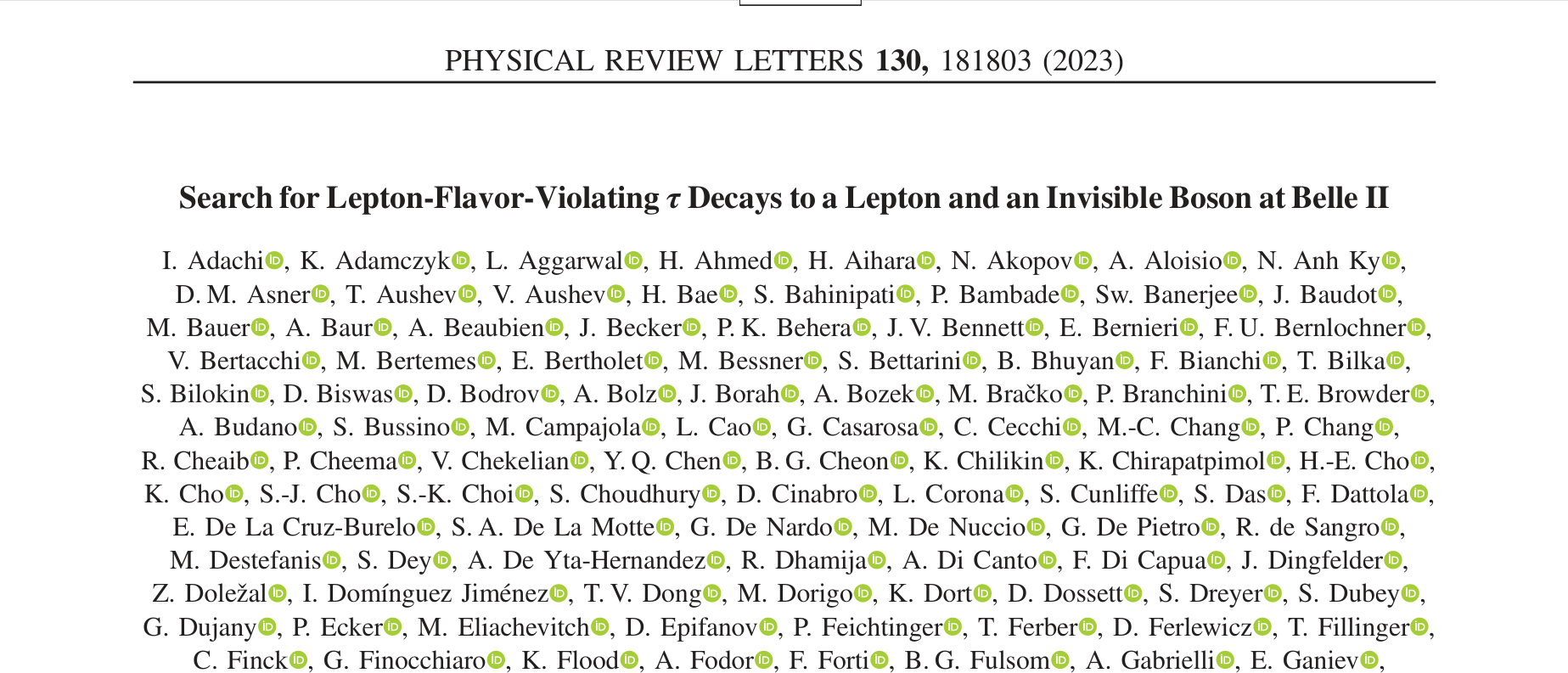
In a recent paper, the Belle II experiment conducted a search for these lepton-flavor-violating (LFV) tau decays. Specifically, they looked for tau decays of the form:
- τ⁻ → e⁻α
- τ⁻ → μ⁻α
In these decays, «α» represents an invisible boson, a hypothetical particle that might be related to dark matter or other unknown physics. This boson would not interact directly with any of the detectors, making its presence detectable only through missing energy.
The Belle II experiment, located at the SuperKEKB accelerator in Japan, is ideally suited for this kind of search. The experiment collides electrons and positrons at very high energies, producing tau particles in abundance. The team then looks for specific signatures in these collisions, using advanced particle detection technology to spot even the smallest deviations from expected behavior.
The Results
The search did not find any evidence of these LFV tau decays, but it did set new limits on how often they could happen if they exist. The results showed that if such decays occur, they do so less frequently than about 1 in 1,000 to 1 in 10,000 tau decays, depending on the mass of the invisible boson.
These limits are the most stringent yet for these kinds of decays, significantly improving on previous results from experiments like MARK III and ARGUS. For example, Belle II set a 95% confidence limit that the branching fraction of τ⁻ → μ⁻α is less than about 0.07% for certain boson masses, which is up to 14 times better than previous experiments.
Why Does This Matter?
While no LFV tau decays were observed, the significance of this result should not be underestimated. First, setting stringent limits helps refine our understanding of what kinds of new physics are still possible. By pushing the boundaries of what is allowed, experiments like Belle II help to rule out or constrain various theories that attempt to go beyond the standard model.
Second, searches like these are crucial in the hunt for dark matter. Invisible bosons, like the «α» particle in this search, could be related to dark matter, which is thought to make up around 85% of the matter in the universe but has yet to be directly detected. By narrowing down where dark matter might exist and how it might interact with ordinary matter, we move closer to solving one of the biggest mysteries in physics.
Finally, this work has implications for understanding other anomalies in particle physics, like the muon’s magnetic moment. If new, unseen particles are responsible for these discrepancies, then detecting or constraining them through experiments like Belle II is a crucial step.
Looking Ahead
The results from Belle II are just the beginning. As the experiment continues to collect more data, physicists will be able to probe even deeper into the possible new physics hiding in tau decays. With larger datasets and improved analysis techniques, the limits on LFV decays will continue to improve, and who knows—perhaps the next discovery in particle physics will come from an unexpected tau decay.
In conclusion, while the latest results from Belle II have not yet uncovered new physics, they represent a major milestone in the ongoing search for answers to some of the biggest questions in particle physics. By setting the most stringent limits yet on LFV tau decays, Belle II is helping to shape the future of particle physics and our understanding of the universe.