
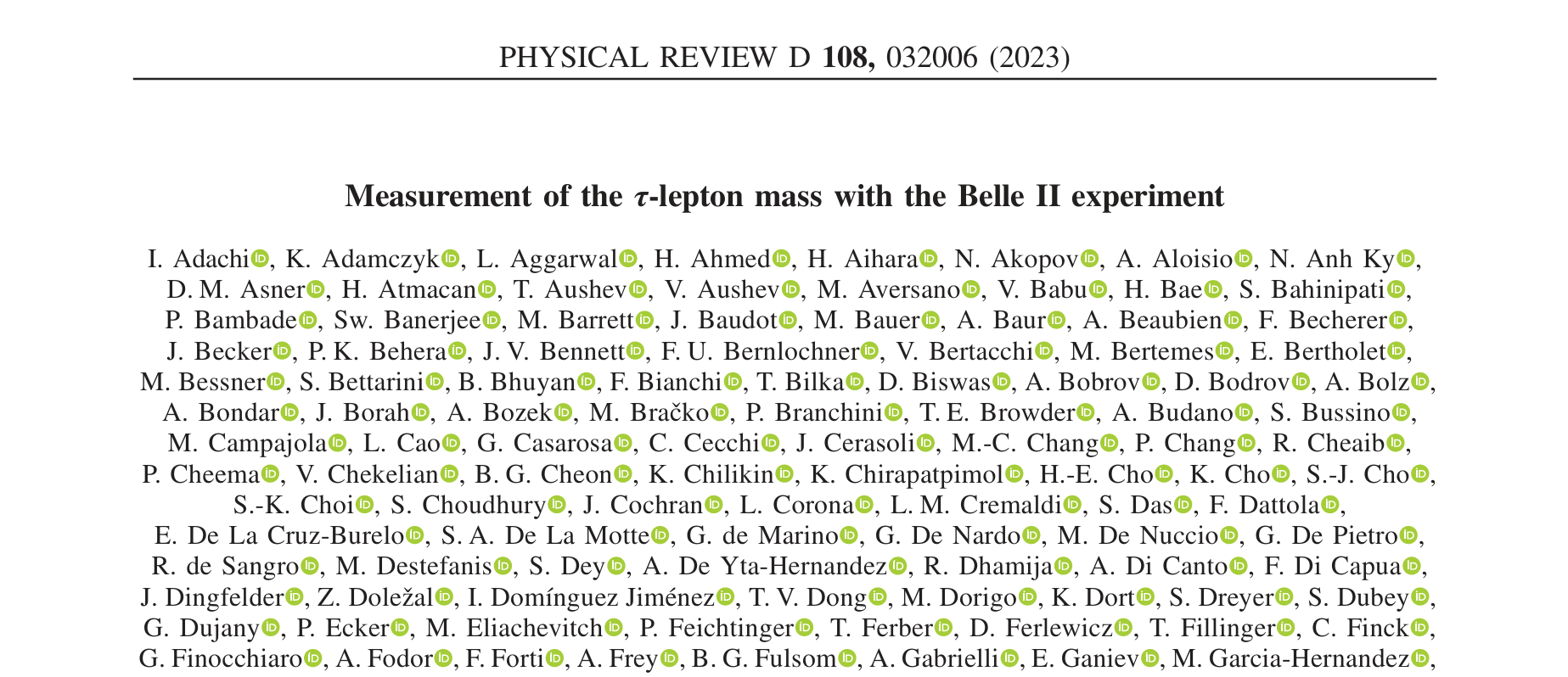
A Brief History of the Tau Lepton: From Discovery to Precision Measurements
The tau lepton, a heavy elementary particle, was discovered in 1975 by the SLAC-LBL collaboration at the Stanford Linear Accelerator Center (SLAC) in California. This discovery marked a significant milestone in particle physics, expanding our understanding of the fundamental building blocks of matter.
The Tau’s Early Years
The tau lepton, often denoted by the Greek letter τ (tau), shares many properties with its lighter counterparts, the electron and the muon. However, it is significantly more massive, with a mass approximately 1,777 times that of the electron. This greater mass allows for a wider range of decay modes, making the tau a particularly interesting particle to study.
Shortly after its discovery, the first measurement of the tau’s mass was performed using the SLAC-LBL detector. While this early measurement provided a rough estimate, it was essential for understanding the tau’s place within the Standard Model of particle physics. The Standard Model, a theoretical framework that describes the fundamental forces and particles of the universe, predicts the existence of three generations of leptons, including the electron, muon, and tau.
The Importance of Precision Measurements
Over the decades following its discovery, the tau lepton has been the subject of intense experimental investigation. One of the key goals of these studies has been to measure the tau’s mass with ever-increasing precision. Why is this so important?
- Testing the Standard Model: Precise measurements of the tau’s mass can help test the predictions of the Standard Model. If the measured mass deviates significantly from the model’s predictions, it could be a sign of new physics beyond the Standard Model.
- Understanding Fundamental Interactions: The tau’s mass is related to its interactions with other particles, such as the Higgs boson. By measuring the tau’s mass accurately, scientists can gain insights into the fundamental forces that govern the universe.
- Search for New Phenomena: Deviations from the Standard Model predictions could also indicate the existence of new, undiscovered particles or forces. Precise measurements of the tau’s properties can help constrain the possibilities for these phenomena.
The Belle II Experiment
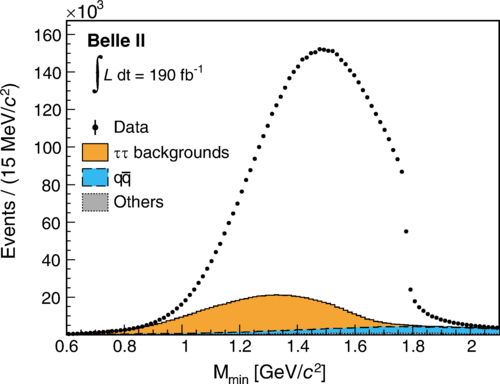
In recent years, the Belle II experiment at the KEK laboratory in Japan has made significant contributions to the study of the tau lepton. This experiment is designed to study the properties of B mesons, but it also provides a wealth of data on tau leptons.
In 2023, the Belle II collaboration announced a new measurement of the tau’s mass with unprecedented precision. This measurement, based on a large dataset collected by the experiment, has significantly improved our understanding of the tau’s properties.
The Future of Tau Physics
As experimental techniques continue to advance, we can expect even more precise measurements of the tau lepton’s mass and other properties. These measurements will play a crucial role in testing the Standard Model and searching for new physics. The tau lepton, once a newly discovered particle, has become a cornerstone of particle physics, offering valuable insights into the fundamental nature of our universe.