
In the world of particle physics, the Standard Model (SM) has been remarkably successful in explaining a vast range of observed phenomena. However, some mysteries remain unresolved, such as the existence of dark matter, neutrino masses, and the muon’s anomalous magnetic moment. These anomalies suggest the presence of physics beyond the Standard Model (BSM). To investigate these unknowns, physicists are turning to tau lepton decays, a promising avenue for discovering new particles and forces.
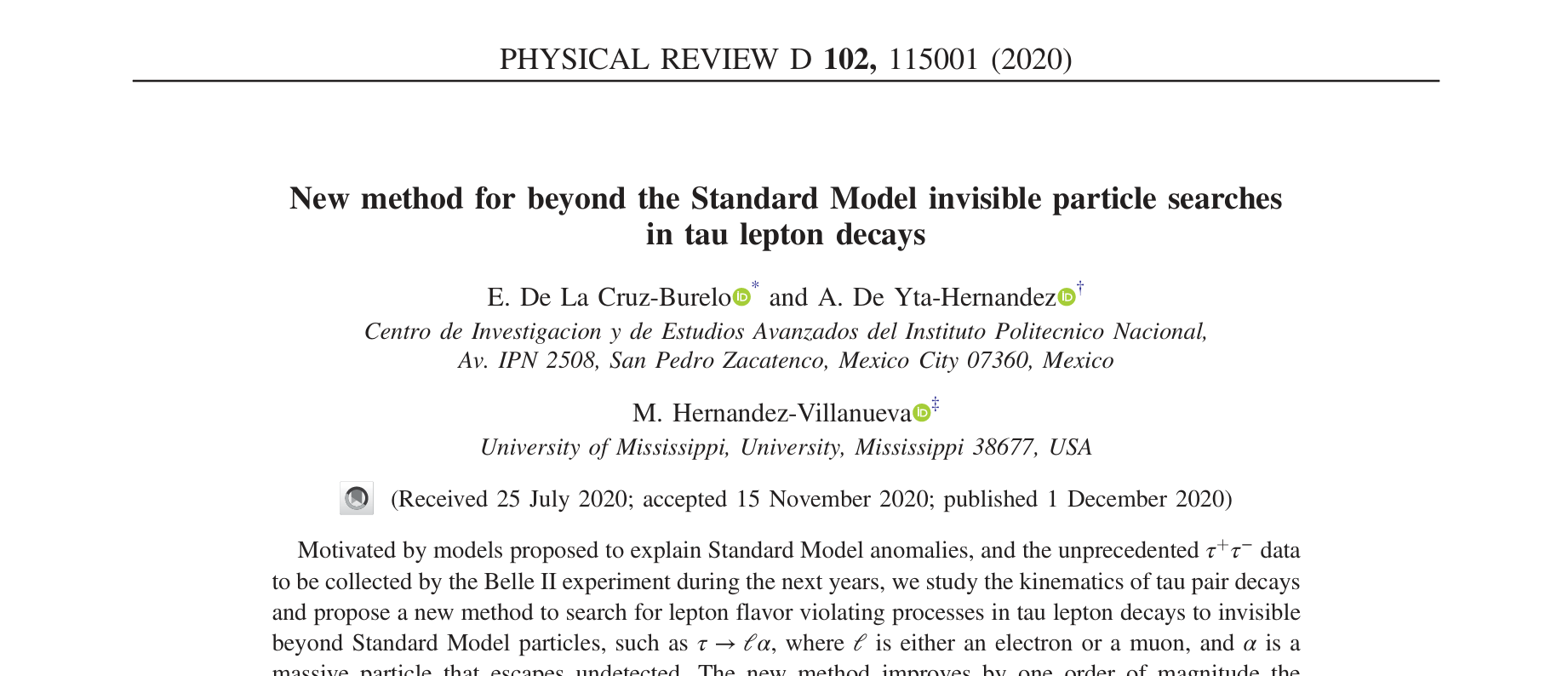
In a recent study published in Physical Review D, researchers from CINVESTAV and the University of Mississippi propose a new method for searching for invisible particles in tau lepton decays. The paper titled «New Method for Beyond the Standard Model Invisible Particle Searches in Tau Lepton Decays» focuses on lepton-flavor-violating (LFV) processes, which are forbidden in the SM but allowed in many BSM theories. Specifically, they explore the decay of a tau lepton into a lighter lepton (an electron or muon) and an undetectable particle, denoted as α\alphaα.
The Importance of Tau Leptons in Particle Physics
Tau leptons are about 3,500 times heavier than electrons and are the heaviest known leptons. This makes them an excellent laboratory for studying LFV processes, as their decays could reveal the existence of new, yet-to-be-discovered particles. In particular, BSM models predict that tau leptons might decay into invisible particles, such as axion-like particles or new gauge bosons like the Z′Z’Z′. These particles could help explain phenomena such as dark matter or the proton radius puzzle, and investigating tau decays provides indirect access to high-energy scales that are otherwise unreachable by current particle accelerators.
A New Search Method: Going Beyond the Standard Techniques
In their paper, the researchers propose a novel kinematic approach to searching for tau decays that result in invisible particles. Traditional methods, such as those employed by the ARGUS Collaboration in earlier searches, rely on reconstructing the tau’s rest frame based on its decay products. This technique has limitations, particularly because tau decays often involve missing particles, making precise reconstruction difficult.
The new method proposed by the authors introduces a two-dimensional analysis that significantly improves the sensitivity of the search. By studying the energy and momentum of visible decay products in tau decays, the researchers derive new variables, Mmin2M_{\text{min}}^2Mmin2 and Mmax2M_{\text{max}}^2Mmax2, which can be used to identify the presence of invisible particles. These variables allow for a more precise separation of potential LFV signals from the background noise of standard tau decays.
Simulating the Search at Belle II
The Belle II experiment at the SuperKEKB accelerator in Japan is expected to collect an unprecedented number of tau lepton pairs, providing a fertile ground for searching for LFV decays. Using simulated data that emulates the conditions of the Belle II experiment, the researchers tested their new method by analyzing tau decays in a 3 × 1 prong configuration—one tau decaying into three charged particles and the other into a single charged particle.
The results showed that the new method, particularly when combining the two variables in a two-dimensional (2D) analysis, provides an order of magnitude improvement in the expected upper limit on LFV tau decays compared to the traditional ARGUS method. This means that with the new technique, Belle II could detect signs of invisible particles using a smaller dataset, potentially accelerating the discovery of new physics.
Implications for Particle Physics and Beyond
While the search for LFV tau decays has not yet yielded a definitive signal, the new method provides a powerful tool for future experiments. If such decays are observed, it would be a clear indication of physics beyond the Standard Model, with far-reaching implications.
- Dark Matter: Many BSM theories predict the existence of very light particles, such as axion-like particles, that could serve as dark matter candidates. Discovering these particles would help solve one of the most pressing mysteries in astrophysics—the nature of the unseen matter that makes up most of the universe’s mass.
- Muon Anomalies: The muon’s anomalous magnetic moment, which deviates from SM predictions, has long puzzled physicists. LFV processes in tau decays could be linked to this discrepancy, potentially providing clues to its resolution.
- Proton Radius Puzzle: Another mystery in physics is the difference in the measured size of the proton when probed with electrons versus muons. New particles involved in tau decays might offer an explanation for this discrepancy.
Looking Forward: Belle II and the Future of LFV Searches
As Belle II continues to collect more data in the coming years, the potential for discovering new particles will only grow. With advanced methods like those proposed in this paper, physicists are better equipped to uncover subtle signals of new physics in the vast data collected from tau decays. The innovative approach of using kinematic variables to improve sensitivity could also be adapted for other searches, such as measuring the mass of the tau neutrino or hunting for heavy neutrinos.
In conclusion, the study represents a significant step forward in the search for BSM physics. By refining the tools available for analyzing tau decays, the researchers are opening up new possibilities for discovering invisible particles that could reshape our understanding of the universe. While the work is theoretical and based on simulations, its real impact will be felt in the coming years as Belle II and other experiments put these ideas to the test. The next breakthrough in particle physics could very well come from an unexpected tau decay.